The ocean expedition
The InvincibleThe ocean expedition is a tightly controlled survey of Regis III’s sea, undertaken by Rohan and a team from the Invincible after orbital observation proves inadequate. Its decisive significance lies in the contrast it reveals: the ocean supports living organisms, while the land remains almost entirely lifeless. The expedition therefore supplies the first concrete basis for understanding Regis III as a divided planetary system rather than an empty world, even as the crew’s scientific methods remain inseparable from military protection, remote machinery, and the search for the lost Condor.
Purpose and Preparation
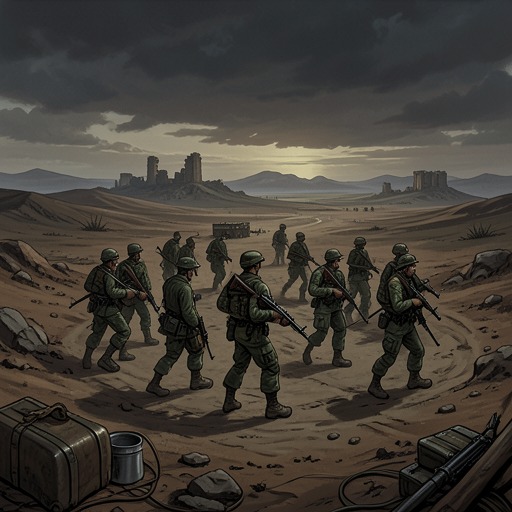
Rohan first considers beginning with photogrammetry, since a complete orbital photographic survey could have taken almost a month and visual observation from orbit offered little useful detail. The decision is instead made to proceed on the ground. A convoy leaves at five in the morning, before sunrise, under the commander’s prohibition against night travel. Its form is a slow cortege: energobots at the front and rear generate an ellipsoidal force field around the vehicles, which include hovercraft, radio and radar jeeps, a field kitchen, a transporter carrying self-assembling hermetic barracks, and a direct-strike laser informally called the punch.
Rohan travels in the leading energobot with three scientists. The convoy moves at the speed of its slowest vehicles, while caterpillar tracks, turbines, conditioned-air vents, oxygen masks, and the uneven rocky terrain make the journey physically oppressive. The Invincible disappears below the horizon as the convoy crosses an unvarying desert beneath the cold, blood-red sun. A narrow, partly dried creek is tested on the way; its water is clean but hard, with iron oxides and trace sulphides. Samples from low bare hills later show silica of organic origin, and limestone appears when the convoy nears the coast.
The sea is first seen as a blue-black line and then, at close range, as a greenish expanse resembling a terrestrial ocean. To protect the working party, the leading energobot is made watertight and guided remotely into the water. Once it has moved far offshore, it raises its Dirac transmitter, establishing an invisible force-field dome over part of the shore and nearby sea. Only after this protective arrangement is complete can the scientists begin their tests.
Marine Survey and Discoveries
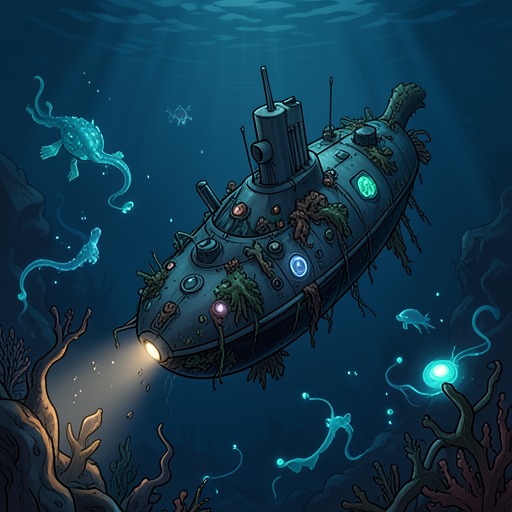
The ocean proves somewhat less saline than Earth’s, but the initial tests reveal no immediate surprise. The expedition then sends two remotely controlled televisual probes out to sea, tracking them from monitors at the command post. Their signals change only after the probes pass beyond the horizon: organisms resembling bony fish are detected in the water. They flee from the machines at immense speed and seek refuge in the depths, making direct observation and capture difficult.
Broza insists on obtaining a specimen. The probes pursue twisting shadows through the greenish water, firing electrical discharges, and succeed only after multiple attempts. One probe catches a creature in its pincers and returns with it. The other gathers floating fibers believed to be local algae or seaweed before descending toward the seabed. At a depth of eight hundred feet, a powerful current repeatedly pushes the probe toward submerged rocks, but the operators eventually move some of those rocks aside. Beneath them they find a colony of supple, brush-like organisms.
The findings support Rohan’s earlier suggestion that life might exist beneath the ocean and remain concealed from the barren continents, though they do not support his more speculative idea of an intelligent aquatic civilization. The evidence is biological rather than civilizational: fish-like vertebrates, algae-like fibers, and brush-like organisms, none of which is presented as a builder of cities or a conquering intelligence. The expedition thus replaces imaginative conjecture with a narrower but more secure account of marine life.
Scientific Results
After the probes return, the biologists begin examining the captured organism in the temporary barracks, where Rohan, Jarg, and five other men eat their first hot meal of the day. The remainder of the expedition is devoted to methodical work: mineral sampling, measurements of radioactivity near the ocean floor, tests of insolation, and many other routine procedures required for valid results. The scene emphasizes that discovery depends less on a single revelation than on a long sequence of controlled, repetitive measurements.
By evening, the team concludes that the ocean is full of living forms, but that all of them avoid the coastal zone. Dissection of the fish reveals no especially remarkable anatomy by terrestrial standards. Its bone structure is ordinary for a vertebrate, and the division between plant and animal life appears standard. One organ, however, has no known terrestrial equivalent: it is sensitive to extremely subtle changes in magnetic-field intensity.
The survey also helps establish Regis III’s deep history. Preliminary estimates place the planet’s biological evolution hundreds of millions of years in the past. Large quantities of green algae explain the oxygen in the atmosphere, while the absence of land life becomes increasingly striking. Rohan and the expedition’s scientists therefore begin to see the ocean not as a marginal region but as the remaining active biological sphere of the planet.
Relation to the Barren Continents
Before the expedition, the apparent contradiction between oxygen in the atmosphere and the absence of visible terrestrial life had encouraged competing explanations. Rohan imagines hidden underwater beings; the captain rejects the idea that intelligent aquatic organisms would have failed to conquer the land. The ocean survey does not resolve the entire mystery, but it establishes the crucial ecological division on which later interpretations depend: marine life survives, whereas land life has disappeared.
Subsequent geological work strengthens that contrast. Sedimentary strata contain evidence that land evolution once occurred, including fossils of plants adapted to dry conditions and remains of primitive reptiles that lived roughly three hundred million years ago. Yet the more recent strata show the progressive disappearance of plant and animal traces, alongside metallic layers and localized radioactive centers. The destruction of terrestrial life cannot be explained simply by the measured radiation, whose total was equivalent to only twenty or thirty megatonnes spread across hundreds of thousands of years.
The ocean expedition consequently becomes part of a larger planetary diagnosis. Its algae account for the atmosphere’s oxygen, while its surviving organisms occupy a domain apparently insulated from the process that erased life on land. Later discussion proposes that an ancient mechanical evolutionary process may have transformed remnants of an extinct civilization into something resembling a natural force. Whether or not that hypothesis is accepted, the marine findings make clear that Regis III is not biologically dead in every region; its life has been unevenly distributed across a planet marked by a profound sea-land rupture.
Consequences and Significance
The scientific program is interrupted when Horpach orders the team to return after the Invincible’s crew probably identifies the place where the lost Condor landed. The biologists protest that even several weeks of additional testing would be insufficient, but the barracks is dismantled, the engines restart, and the convoy turns northwest. Rohan is eager to reach the ship, both because he expects another mission and because he wants to investigate the Condor’s presumed landing site.
The expedition’s results do not produce a simple victory over the unknown. They generate usable facts while leaving the central danger unresolved. The captured fish, the elusive deep-water organisms, the algae, and the magnetically sensitive organ all widen human knowledge, but none explains the fate of the Condor or the artificial-looking ruins on land. The expedition therefore illustrates the limits of scientific classification when evidence crosses from familiar biology into a planetary history shaped by metallic strata, vanished civilizations, and nonhuman processes.
Its later significance is also ethical. The crew’s impulse is to map, sample, excavate, and secure the planet, while military command seeks certainty about formations that might threaten future space travel. Rohan eventually recognizes the danger of treating an unfamiliar planetary equilibrium as an enemy merely because it does not resemble humanity. The ocean survey is the moment when that recognition acquires material grounding: Regis III contains forms of life that do not exist for human purposes, and the fact that they can be measured does not make the planet an empty space available for conquest.